
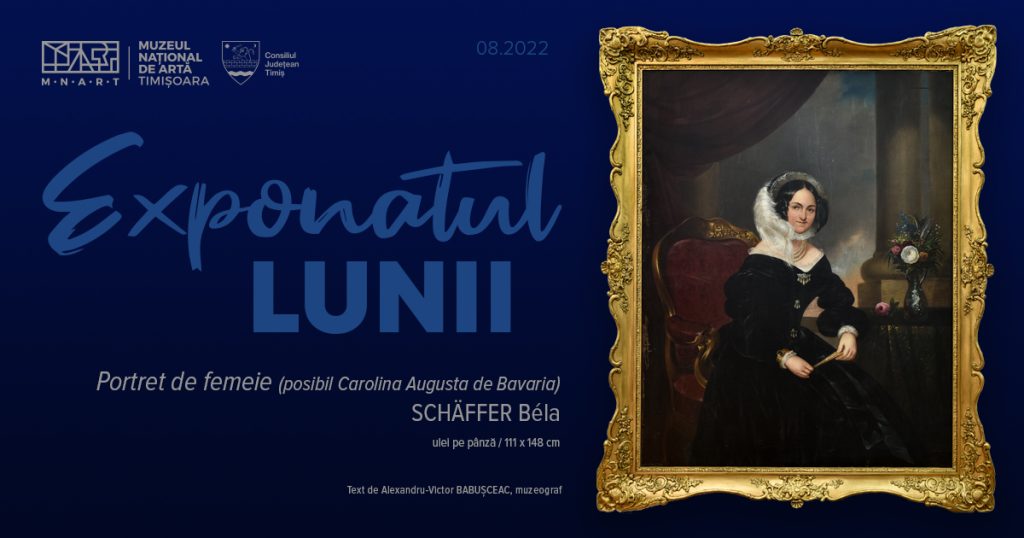
Exhibitor of the month August 2022
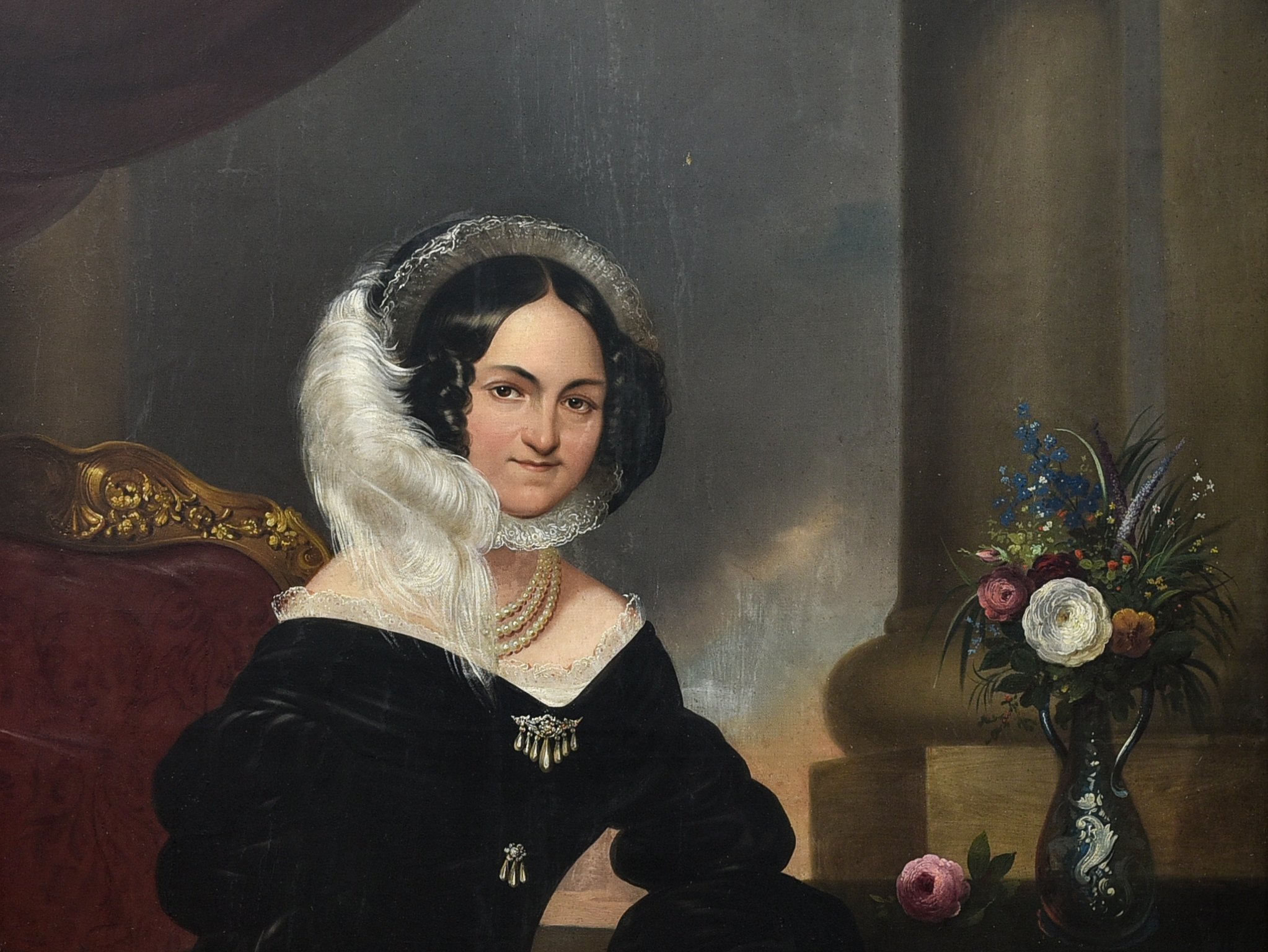
Portrait of a Woman
Research work may seem tedious at times, but it is always full of surprises. Thanks to these efforts, we discover new things about the past that were lost in our collective memory.
One of the most memorable works in the collection of old Banat art of the National Art Museum Timișoara is “Portrait of a Woman” by Schäffer Béla, painted in 1843. By a favorable chance, the mystery of this lady’s identity could be elucidated. The portrait in Timișoara is similar to the portrait of Empress Caroline Augusta as a widow painted by Franz Schrotzberg in 1864 in Salzburg. If the hypothesis is correct, the Timișoara portrait predates the Salzburg portrait by two decades. The model’s clothes, which are in the fashion of the late Romantic period (3rd-4th decades of the 19th century), are identical to those in the Salzburg portrait, thus supporting the theory of the model’s princely identity.
Caroline Augusta of Bavaria, Empress of Austria and Consort Queen of Hungary, came from the Wittelsbach dynasty, whose fate would be linked to that of the Habsburg-Lorraine dynasty through the political marriages between the two families. She was the fourth wife of Emperor Francis I, whose reign was marked by tumultuous changes for central and south-eastern Europe. Defeated by Napoleon, Francis abdicated from his position as Emperor of the Holy Roman Empire of the German nation, a secular political entity that had survived for 1000 years since the time of Charlemagne. His personal life was also marked by tragedy. The emperor’s first three consorts died in their youth. At the age of 48 he married Princess Caroline Augusta, who was 24. The young Empress traveled with her husband to Hungary and Transylvania, arriving in Cluj in 1817, where the townspeople erected the Carolina obelisk, the oldest secular monument in the city, in honor of the Empress’s visit.
Portraits of the imperial couple circulated in the kingdom by means of engravings made after the official portraits. Thus, the existence of this portrait in Timișoara, one of the major urban centers of the region, is justified. These portraits were found in public institutions as well as in private residences.
The subject will be studied further, but if our assumption is correct, Augusta Carolina may join her family, whose portraits are in the museum’s collection, and which we hope to be able to present to the public in the near future.
————————————
http://www.royaltyguide.nl/images-families/wittelsbach/bavariakings/1792%20Karoline.jpg

https://upload.wikimedia.org/wikipedia/commons/f/fc/Karoline_Auguste_von_Bayern.jpg
https://www.meinbezirk.at/salzburg-stadt/c-lokales/johann-rauzi-franz-schrotzberg-portrait-der-kaiserin-witwe-caroline-auguste-1864-oel-auf-leinwand_pic1607633_a1378456#gallery=default&pid=1607633