
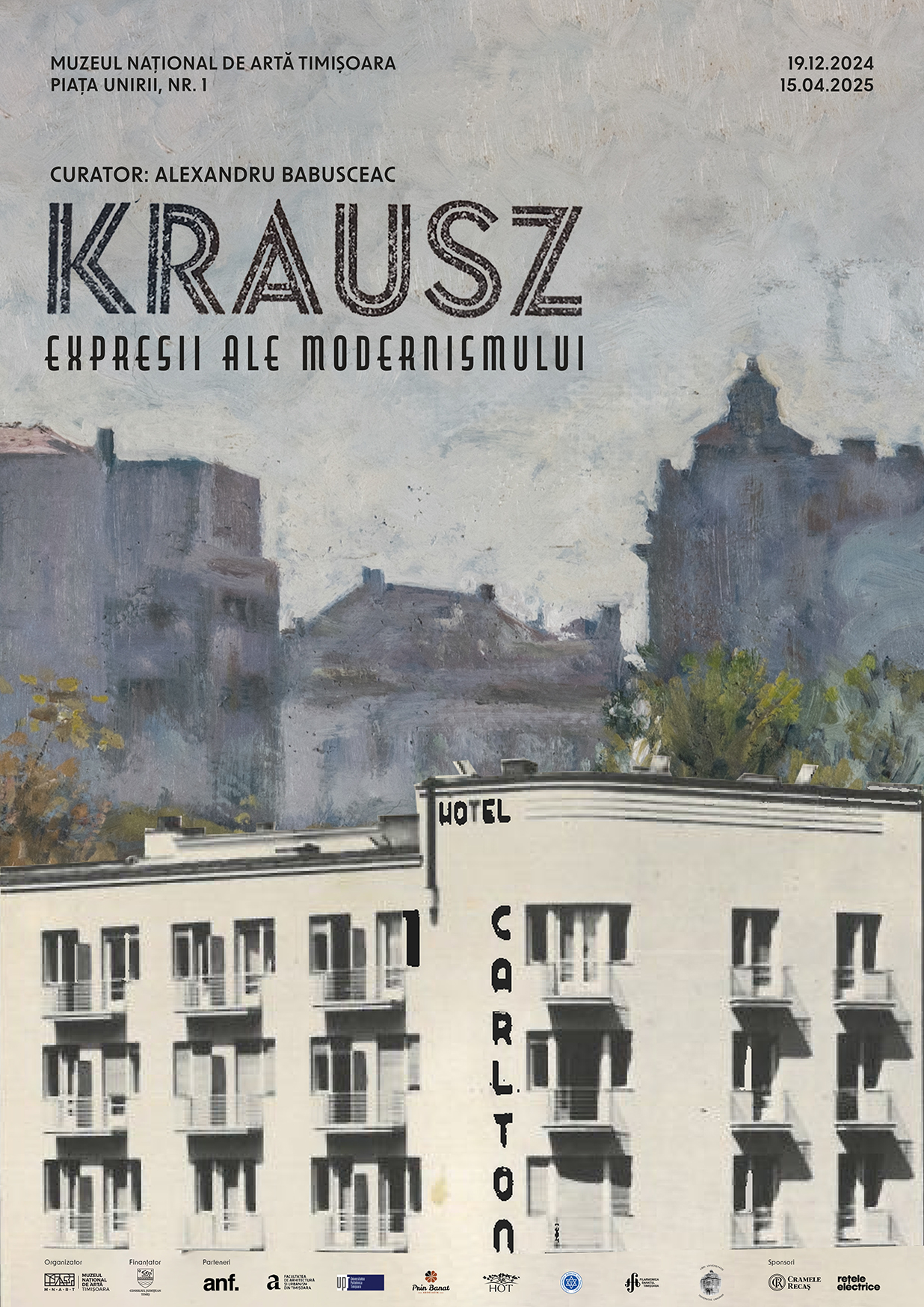

Albert Kristóf-Krausz’s contribution to shaping urban space and local art in a new temporary exhibition at MNArT
The National Art Museum Timisoara brings to the forefront the work of Albert Kristóf-Krausz, a prominent personality of the interwar generation of artists from Timisoara, with the opening of the temporary exhibition “Krausz – Expressions of Modernism”. The opening will take place on Thursday, December 19, 2024, at 18:00 in the Arcada Gallery.
In the inter-war era to which it belonged, often forgotten or deliberately ignored in the decades that followed, the foundations were laid for the cultural development of the city, favoring an opening towards modernity, an integration into the cultural context of inter-war Europe and a starting point for artists who transformed Timișoara into a center of the Romanian avant-garde.
If the interest in Albert Kristóf-Krausz’s work in recent years has been manifested only through activities to promote the city’s built heritage and research studies, the National Art Museum Timisoara brings to the public’s attention for the first time, the artistic vein alongside his work as an architect, contextualized in an innovative way.
Krausz is special not only for his two-dimensional works (cityscapes, rural landscapes and portraits of the city’s intellectual elite), but also for the way he marked the urban development of historic neighborhoods by inserting modernist buildings, strongly influenced by the austere elegance of the Bauhaus school. Today, members of the architectural community recognize his contributions to the shaping of the local urban space, while visual arts scholars who study his works can confirm the artist-architect’s talent in the visual arts.
The exhibition “Kraus-Expressions of Modernism” aims to promote this important personality for the local culture, presenting to the public a perspective on the developing art scene of that period. It explores the aspirations of a generation of artists who wanted to contribute to the revitalization of the city, but who were marginalized in the post-war era, forgotten and often categorized as reminiscent of the bourgeoisie.
The exhibition brings together paintings from the collections of the Timișoara National Art Museum, the Banatul Timșoara Philharmonic, the Jewish Community of Timișoara, as well as from private collections. In addition to these, the public will be able to consult unpublished documents from the National Archives of Romania – Timis County, the patrimony of the Central University Library “Lucian Blaga” Cluj-Napoca and the Association Prin Banat/Heritage of Timisoara, presented for the first time in an exhibition of this kind. During the event, visitors will also be able to view models realized in collaboration with the Faculty of Architecture and Urbanism of the Politehnica University of Timișoara and the Non-Formal Spatial Planning Workshop of Timișoara, which illustrate Krausz’s modernist vision of urban space.
The initiative is part of a wider endeavor of the National Art Museum Timisoara to bring to the attention of the local public the interwar generation of artists and architects who contributed to the multi-ethnic cultural identity of the city.